💰
Budget
How Much Does a Sensory Room Cost? A Realistic Breakdown
Real price ranges for home, classroom, and clinic — plus the hidden costs nobody budgets for.
The catalog makes a sensory room look like a shopping problem. It is not. Four kinds of input cover nearly everything a child needs from the room — and most of the catalog is a variation on equipment you only need once.
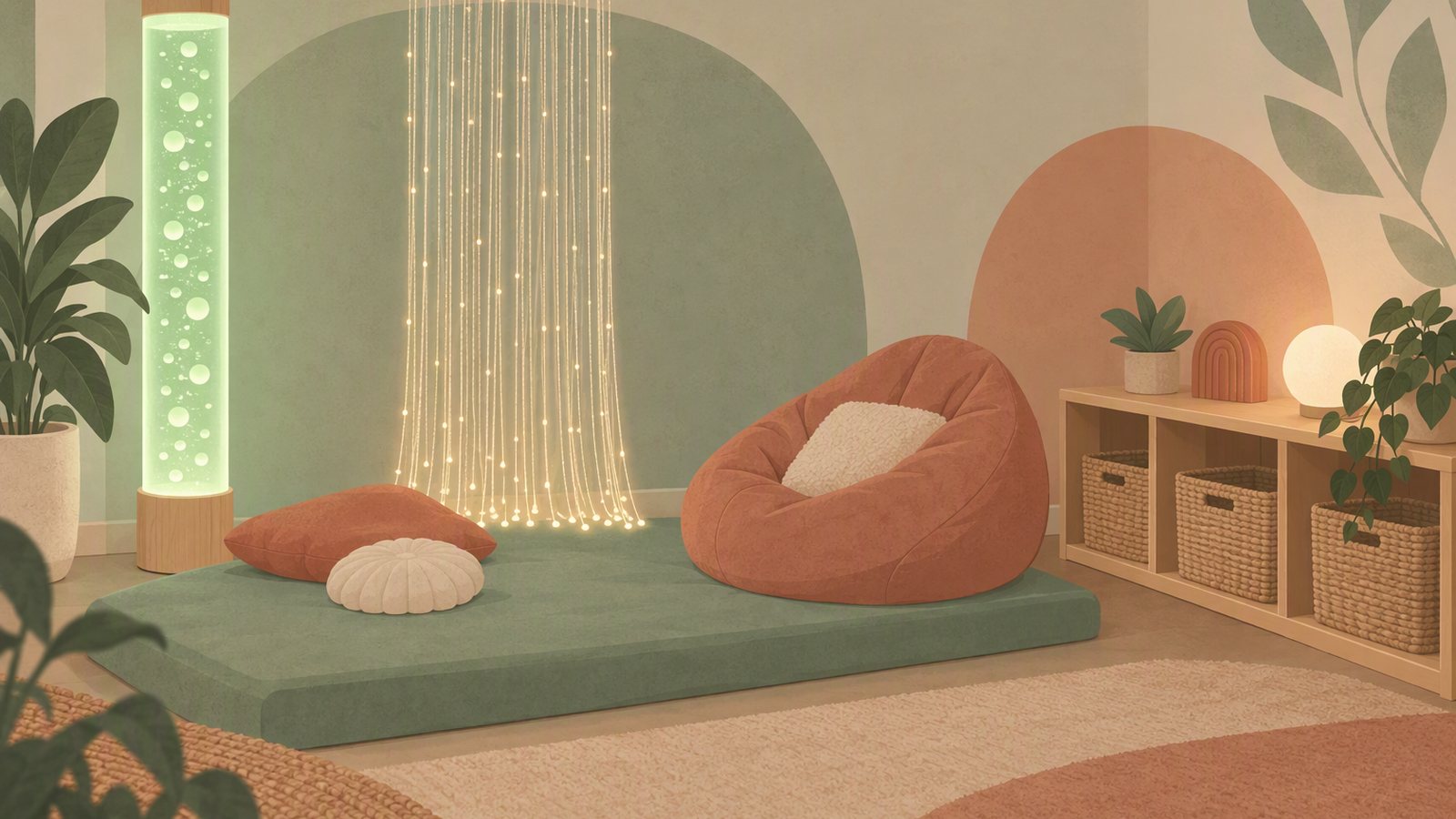
A sensory room has five jobs, not fifty products. Visual input to watch, auditory input to soften the world, tactile input to touch, proprioceptive input to push against, and vestibular input to move through. Buy one good thing per job, and you have a room. Buy everything in the catalog, and you have a storage problem.
That is the organizing idea of this list, and it is the way occupational therapists think about it. The framework goes back to A. Jean Ayres, the occupational therapist who developed sensory integration theory and wrote Sensory Integration and the Child: equipment earns its place by feeding a sensory system, not by looking impressive in a catalog. A 2026 systematic review in the American Journal of Occupational Therapy (Piller and colleagues, 12 studies from 2015–2024) reached a similar conclusion from the evidence side — what matters is matched, purposeful input, not the quantity of equipment.
Prices below are real prices for named products, checked on November 16, 2026, or marked "about" where they are typical ranges for unbranded items. The full budget picture, including hidden costs and funding routes, is in how much a sensory room costs.
Everything in this guide, in one table. Start at the top of each column and stop when the job is covered — a second item in the same row is a luxury, not a need.
| Equipment | System | Verdict | Typical price |
|---|---|---|---|
| Platform or pod swing | Vestibular | Buy first | $487 (Southpaw platform, named) |
| Crash mat or crash pit | Proprioceptive | Buy first | from $367 (Southpaw Mini Crash Pit) |
| Pop-up tent or canopy | Calming / visual | Buy first | about $35 |
| Tactile bins + textures | Tactile | Buy first | about $30–50 |
| Weighted lap pad or blanket | Proprioceptive / tactile | Buy first | $109 (Dreamland weighted blanket) |
| Dimmable lamp / string lights | Visual | Buy first | about $25–40 |
| Body sock | Proprioceptive / tactile | Worth it | about $25 |
| Noise-reducing headphones | Auditory | Worth it | about $20–30 |
| LED projector | Visual | Worth it | $459 (Optikinetics Aura) |
| Climbing frame / monkey bars | Proprioceptive + vestibular | Worth it | $850–1,500 for a frame |
| Beanbag / floor cushions | Calming / tactile | Worth it | about $50 |
| Sensory wall panels | Tactile / visual | Worth it in small spaces | see sensory wall ideas |
| Fiber-optic strands | Visual / tactile | Nice-to-have | $1,303.88 (TFH bundle) |
| Bubble tube | Visual | Nice-to-have | $729 (TFH Budget Bubble Tube) |
| Balance board / stepping stones | Vestibular | Nice-to-have | about $30–60 |
| Second swing, extra light-up toys | — | Skip | — |
Visual equipment does one job: give the eyes something slow, predictable, and gentle to follow. That is the whole of the classic multi-sensory room tradition — dim light, one glowing object, nothing that startles. The mistake is buying four glowing objects. One is the point; the rest is clutter.
The TFH Budget Bubble Tube ($729, switch-adapted) is the iconic piece, and children do love watching one. But it is the most expensive single item in most rooms, and it does only this one job. The Optikinetics Aura LED Projector ($459) covers the same ground — slow-moving light on the wall or ceiling — for less money and no water, no pump, and no leak to mop up. Fiber-optic strands, such as the TFH Fiber Optic Light Bundle ($1,303.88 for 100 strands), add touch to the light: a child can hold the strands, which is why they survive in clinics. At home, a dimmable lamp and a color-changing bulb do most of the calming for about $25–40, and that is where most families should start.
The rule for this column: one light source the child watches, plus dimmable room light. If you already own a projector, you do not need a bubble tube. If you own a bubble tube, you do not need fiber optics as well — unless your child specifically seeks the feeling of the strands in their hands.
Sound equipment is the most overlooked column, because it is mostly about removing sound rather than adding it. A room with a humming fridge, a buzzing fluorescent tube, and a washing machine next door is a room a sound-sensitive child cannot settle in, whatever else you buy.
Start with the room itself: a rug or soft flooring under the play area, the noisy appliance scheduled for another time, and the flickering bulb replaced. Then add two things. First, noise-reducing headphones within the child's reach, no permission needed — about $20–30 for a children's pair, and the single most-used item in many rooms. Second, one gentle sound source: a small white-noise machine, a tabletop fountain, or slow music on a speaker. Pick one; a room does not need a soundtrack and a fountain and a rain machine.
The tactile column is the cheapest on the list, and the one most families overbuy in reverse — they buy the expensive panels first and skip the bins. A shallow bin of dried rice, kinetic sand, or water beads with scoops costs about $30–50 to assemble and gets more hands-on use than most wall panels. Rotate the contents and it stays interesting; a bin that never changes becomes furniture.
Deep pressure is the other half of this column: input that presses on the body rather than the hands. A Dreamland Baby Dream Weighted Blanket (toddler, 4 lb, $109) is the named example, and a weighted lap pad does the same job in a portable form for reading and homework. A body sock — a stretchy lycra sack a child climbs into and pushes against — costs about $25 and delivers full-body pressure plus resistance in one piece of fabric. Follow the weight guidance on the label for any weighted product, and never use a weighted blanket for unsupervised sleep or for a child who cannot remove it themselves.
For the wall, sensory wall ideas covers panels in detail, including named TFH panels with real prices — a wall panel earns its place fastest in a small room, where it adds tactile variety without taking floor space.
Proprioceptive input is muscles and joints working under load — climbing, hanging, pushing, crashing. Occupational therapists call it "heavy work," and it is the most organizing input in the room: the one that most reliably settles a child who is revved up. It is also the input that is nearly free, because it comes from work, not gear. Pushing a loaded laundry basket, carrying books, wall push-ups, and a duvet cover stuffed with old pillows all count, and cost nothing.
The piece worth paying for is the landing. A Southpaw Mini Crash Pit (from $367) is the contained version: a pit a child can dive into without the room turning into a hazard. A folding gym mat or crash pad does the same job for about $80–120 and doubles as the impact mat under any climbing zone. Buy the landing before the climbing: a child who can crash safely will use the room; a child who crashes onto a hard floor will stop.
Above that, a climbing frame with monkey bars is the anchor purchase — the one structure that supplies proprioceptive and vestibular input together. Wall-mounted and floor-standing steel frames run about $850–1,500, and they are the only way to have a swing, a climb, and a hang in one footprint. Check the weight rating before you buy, check that it mounts into studs or a tension system rated for the load, and remember that a frame is a permanent fixture: measure twice, including ceiling height and swing clearance, before ordering.
The swing is the most important piece in the room, because it is the only one that supplies vestibular input — movement of the head through space — and nothing else substitutes for it. A child who spins, rocks, or hangs upside down off the sofa is asking for this input. Give it a safe place to happen and the sofa survives.
One good swing is enough, and the choice is between two styles. A Southpaw Soft-Lite Round Platform Swing (29.5 in, 300 lb working load, $487; safety rotational device sold separately) lets a child sit, lie, or kneel and move in any direction, which suits seekers who want big movement. A pod or cocoon swing wraps the body while it sways, adding gentle pressure to the movement, which suits children who want motion and enclosure together. Linear back-and-forth swinging is calming; spinning should be sparing and child-controlled, never adult-driven.
The real decision is not the swing but what holds it. A ceiling mount must go into a joist or a rated frame — never into drywall alone, never into a hook rated for a plant. If you cannot mount safely, buy a floor-standing frame or a pod swing on a stand instead of a stronger hook. An adult should be present for all swinging, and the swing comes down or gets tied up when the adult leaves the room.
Each tier below is a complete, usable setup on its own, and each one folds into the next, so nothing bought early is wasted. Pick the tier that matches the space and the child you actually have, not the room in the catalog.
| Build | What goes in it | About |
|---|---|---|
| Under $200 — the proof of concept | Pop-up tent, floor cushions or beanbag, body sock, weighted lap pad, dimmable string lights, a tactile bin and a few fidgets | About $200, and most families already own half of it. Enough to learn what your child reaches for before spending more. |
| About $500 — the half-room | Everything above, plus a real crash mat, a tactile station, and a light projector | About $500. The movement starts here, and this is the tier where most families should stop and watch for a month. |
| $1,200–2,000 — the full active room | Everything above, plus a steel frame with a swing and monkey bars | The frame is the cost. One purchase, three jobs, and the anchor the rest hangs from — literally. |
What none of these tiers include is the clinic version: bubble tubes, fiber-optic bundles, and interactive wall panels quoted at $5,000 to $25,000 and up for schools and clinics. Those prices are real — see how much a sensory room costs — but they buy a different kind of room, and a home does not need it. If a specific piece in that range is the one your child is drawn to, buy that one piece; do not buy the package to get it.
A second swing, a third light-up toy, another set of fidgets. Duplicates are the most common waste in sensory rooms, and they are how a $500 room becomes a $1,500 room without getting any better. One per job, then stop.
Any swing, frame, or climbing attachment without a stated weight limit is a skip, at any price. If the listing does not say what it holds or what it mounts into, the manufacturer is telling you something.
Buying everything before watching what the child uses is the single most expensive mistake in this guide. Build the under-$200 tier, watch for a month, and let the child's actual reaching decide the next purchase. The room that grows with the child beats the room that arrives in one delivery.
A projector, a bubble tube, fiber optics, an LED panel, and a lava lamp in one room is not a sensory room; it is a disco. One watched light plus dimmable room light is the whole visual column. Spend the difference on the crash mat.
Switch-adapted bubble tubes, interactive panels that need a technician, anything that requires a dedicated circuit or a service contract. At home, the test is simple: if you cannot set it up, clean it, and fix it yourself in an evening, it does not belong in a home room.
A small room is not a smaller version of a big room; it is a room where the checklist matters more, because there is no space for the second of anything. The four jobs fit in roughly the footprint of a loveseat: a wall-mounted frame or doorway swing, a folding crash mat that stands behind a door, a tactile bin on a shelf, and a pop-up tent that folds flat. Wall panels do the tactile work without floor space, and a dimmable lamp replaces a whole lighting rig.
What a small room cannot hold is a swing that needs clearance in every direction. If the swing arc does not fit, buy the pod swing and the crash mat and skip the frame — the room will still do its four jobs. And use the vertical space: hooks at adult height for the swing when it is not in use, shelves for the bins, and the tent folded behind the door keep the floor clear enough for the crashing to actually happen.
Run through this before the first use, and again after anything is moved or re-hung. The American Occupational Therapy Association's sensory integration practice resources and the NHS's sensory circuits guidance are the authoritative starting points if you want the clinical background behind any of this.
Ceiling mounts into joists, wall frames into studs, tension frames checked after installation and monthly after that. Tug-test everything an adult can tug before a child hangs from it.
The limit on the swing is the limit for everyone on it, including a parent demonstrating. A 300 lb working load is not a suggestion.
Swings, climbing frames, and trapeze bars are used with an adult in the room. The swing is tied up or taken down when the adult leaves.
A crash mat or crash pit sits under the swing and the climbing zone, every time, not just on the days you remember.
Check the weight guidance on the product, never use a weighted blanket for unsupervised sleep, and never use one for a child who cannot remove it themselves. If in doubt, ask the child's occupational therapist.
Four things cover nearly every need: one good swing for vestibular input, a crash mat or crash pit for proprioceptive heavy work, a tactile station of bins and textures, and an enclosed dim corner with soft seating for calming down. Everything else is a variation on one of those four, or a nice-to-have. Start with those, watch what your child reaches for, and add only what earns its place.
A working setup starts under $200: a pop-up tent, floor cushions, a body sock, a weighted lap pad, and dimmable lights. Around $500 adds a real crash mat and a tactile station. A full active room with a steel frame, swing, and climbing attachments lands around $1,200 to $2,000. Clinic-grade installations with bubble tubes and interactive wall panels run $5,000 to $25,000 and up, which is why most families build the home version instead.
The swing, because it is the only piece that supplies vestibular input — movement of the head through space — and no other item substitutes for it. But the swing is only as good as what holds it: a ceiling mount must go into a joist or a rated frame, never into drywall alone. If you cannot mount safely, a floor-standing frame or a pod swing on a stand is the right call, not a stronger hook.
No. A bubble tube is the classic visual piece, and children love watching one, but it is one of the most expensive items in the room — the TFH Budget Bubble Tube costs $729 — and it does only one job: calm visual input. A $459 LED projector or a set of fiber-optic strands does the same job for less, and a dimmable lamp plus a tent does most of the calming for very little. Buy a bubble tube because your child is drawn to it, not because a checklist says a sensory room needs one.
Skip duplicates first: a second swing, a third light-up toy, another fidget set. Skip anything that mounts to drywall without a rated anchor, any swing or climbing frame without a stated weight limit, and light-up panels that do the same job as a projector you already own. And skip buying the whole catalog at once — the single most common waste in sensory rooms is equipment bought before anyone watched what the child actually uses.
Yes. The four jobs fit in roughly the footprint of a loveseat: a wall-mounted frame or a doorway swing, a folding crash mat that stands behind a door, a tactile bin on a shelf, and a pop-up tent that folds flat. Wall-mounted panels do the tactile work without floor space, and a dimmable lamp replaces a whole lighting rig. What a small room cannot hold is a second of everything, which is why the checklist matters more, not less, in tight spaces.
Basic equipment — soft seating, tactile bins, dim lighting, a tent — is safe for any family to set up with common sense and adult supervision. Anything that holds a child's weight in the air — swings, climbing frames, trapeze bars — needs a rated mount installed into structure, a stated weight limit respected, and an adult present. If your child has a diagnosis, a therapy plan, or a history of falls or seizures, check with their occupational therapist before adding movement equipment.
The list is the what; the next step is the how much and the how. For the full budget picture, see how much a sensory room costs, and for the wall — the piece that earns its place fastest in a small room — see sensory wall ideas. The room also needs its quiet half, which is what a calm down corner covers, and the breathing practice that goes with it is in breathing exercises for kids. And the printables library has the free emotion wheel, a feelings chart, and a 50-item coping skills list.
A calm corner sign, a rules poster, and slow breathing cards — free to download right now. The feelings chart, emotion wheel, and coping skills list come by email.
Free for personal and single-classroom use.
Real price ranges for home, classroom, and clinic — plus the hidden costs nobody budgets for.
The five types, 24 mountable ideas, and how much weight a wall really holds.
Eight techniques, how to teach them, and how to adapt them for anxiety, ADHD, and autism.